Key points
- Mobile forensic acquisition means copying the contents of a smartphone using a documented method, then guaranteeing the integrity of the copy with a SHA-256 cryptographic hash.
- What can be extracted depends on the model, the operating system version, the state of the device (on, locked, BFU or AFU) and encryption.
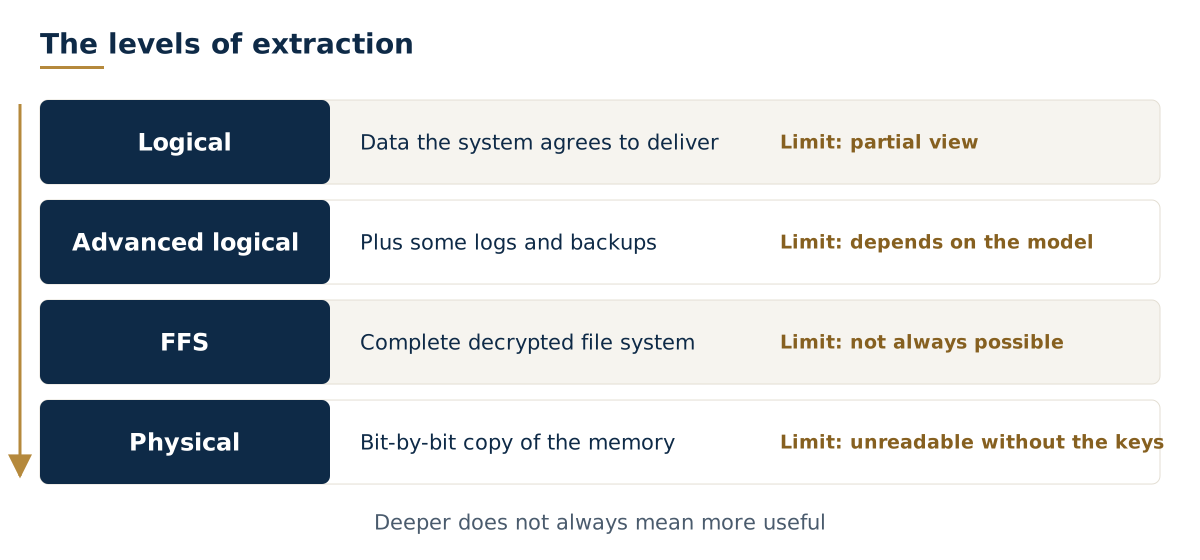
- There are several levels of extraction: logical, advanced logical, full file system (FFS) and, on some devices, physical. The deepest is not always the most useful.
- Some methods leave limited technical traces on the device: they are controlled and recorded in the report.
- The report distinguishes acquisition, analysis and interpretation, and always states what could not be obtained.
What is mobile forensic acquisition?
Mobile forensic acquisition is the operation that extracts data from a smartphone, a tablet or another mobile device so that it can then be analysed on a copy. NIST defines mobile device forensics as recovering digital evidence under forensically sound conditions, using accepted methods. Three requirements characterise it: a method suited to the device, verifiable integrity and complete traceability.
Ordinary backup or forensic acquisition: what is the difference?
An iCloud, iTunes or Google backup is designed to restore a phone. It only contains what the manufacturer and the apps choose to put in it, and it says nothing about how it was produced. A forensic acquisition, by contrast, is documented step by step, time-stamped and sealed with a hash, and it can go beyond the backup: internal app databases, system logs, usage traces. A backup can also serve as a source for acquisition, provided it is handled with the same rigour.
Preserve before extracting
A smartphone that is switched on changes constantly: incoming messages, synchronisation, updates, a remote wipe triggered by someone else. The first measure is therefore to isolate it from all networks (mobile carrier, Wi-Fi, Bluetooth), for example in an enclosure that blocks radio signals, and to keep it powered. Any unnecessary handling is avoided. Our digital evidence guide describes these first steps in detail.
Documenting the initial state
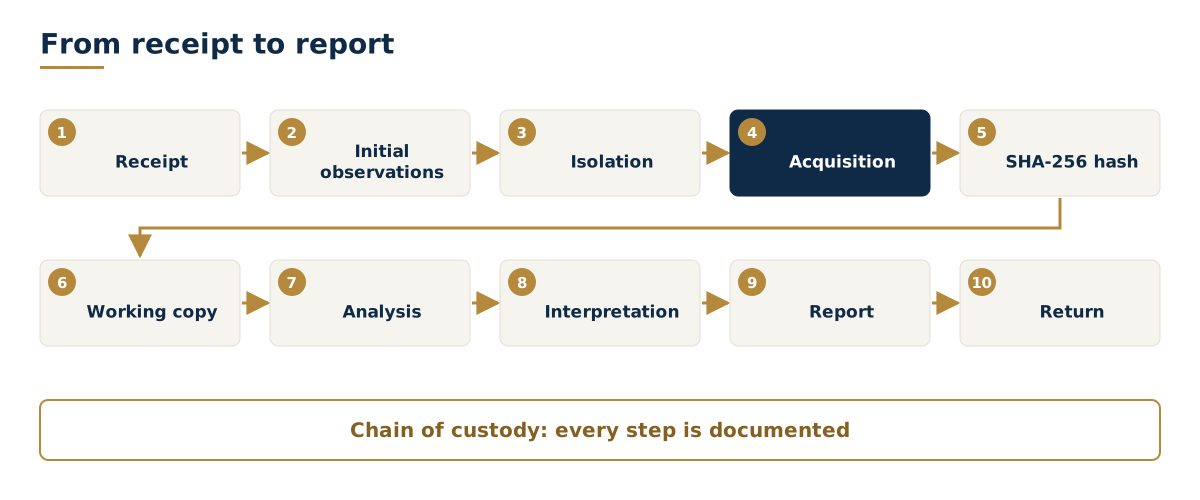
On receipt, the device is photographed and described: model, visible identification numbers, physical condition, on or off, locked or not, battery level, SIM card present, what the screen shows. These dated observations make it possible to explain any difference between the state in which the device was handed over and the state in which it was analysed.
The chain of custody
The chain of custody records the path of each item: who handed it over, to whom, when, in what condition, under which seal, and what operations were carried out. A handover record opens it, an operations log keeps it up to date, and the return of the device closes it. Without it, the integrity of an item becomes difficult to demonstrate.
Encryption on modern smartphones
Recent iPhones and Android phones encrypt user data by default. On the iPhone, Data Protection assigns each file to a class whose keys depend on the passcode. On Android, file-based encryption (FBE), mandatory for devices launched with Android 10 or later, separates storage available from boot and storage tied to the user's credentials. The consequence: without the passcode, or without a prior unlock, a large part of the data remains encrypted, whatever the method.
BFU and AFU: why the state of the device is decisive
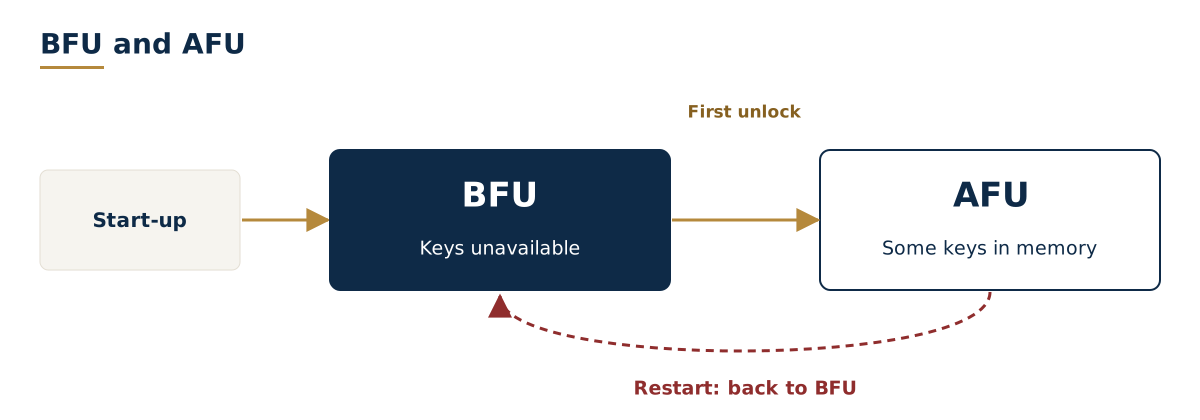
- BFU (Before First Unlock): the phone has been restarted and has not yet been unlocked. The keys that protect most personal data are not available. Extraction options are very limited.
- AFU (After First Unlock): the phone has been unlocked at least once since it was started, even if it is locked again. Some of the keys remain in memory, which opens up more options.
This is why a phone should not be switched off before the examination: a restart puts it back into the BFU state, irreversibly.
The levels of extraction
Logical extraction. The device itself supplies its data through the interfaces provided by the operating system, as for a backup: contacts, messages, call logs, photos, data from many apps. It is the most widely applicable and least intrusive method, but it only sees what the system agrees to deliver.
Advanced logical extraction. It supplements the previous method with other channels provided by the system, for example certain diagnostic logs, password-encrypted backups or file-sharing services. It recovers more traces without touching the security of the device.
Full file system (FFS) extraction. It copies the tree of decrypted files, including internal app databases, system files and many usage artefacts. On recent devices it is often the richest extraction that can actually be used. It is only possible for certain models and versions, in certain states, and may require methods that leave limited traces on the device.
Physical extraction. It copies the memory bit by bit, including unallocated space. On older devices it made it possible to recover deleted data. On modern encrypted smartphones, a physical copy without the keys remains largely unreadable: it is therefore not systematically superior to an FFS extraction, and it is only possible on a limited number of devices.
| Method | Data obtained | Usual conditions | Main limitation | Effect on the device |
|---|---|---|---|---|
| Logical | Contacts, messages, call logs, photos, data from many apps | Device unlocked or computer already trusted | Only sees what the system agrees to deliver | Limited connection traces |
| Advanced logical | Logical data, plus certain diagnostic logs, encrypted backups and file shares | Same conditions, depending on the model | Coverage varies with the system and its version | Limited connection traces |
| Full file system (FFS) | Tree of decrypted files, internal app databases, system logs | Certain models, versions and states only | Not always available; depends on the BFU or AFU state | May require a temporary component, recorded |
| Physical | Bit-by-bit copy of the memory, including unallocated space | Limited number of devices, often older ones | Largely unreadable without the encryption keys | Varies with the method, recorded |
Backups and cloud data, within an authorised framework
Part of a phone's data is also stored in the cloud: backups, photos, synchronised messaging. It is only collected with the agreement of the account holder, and their credentials, or on the basis of a legal authorisation. The collection is documented as an acquisition in its own right, because cloud data can differ from the data on the device.
Android and iOS: two different architectures
Apple designs both the hardware and the operating system: the range is homogeneous and highly protected, and acquisition options depend closely on the model and the iOS version. Android is an open system used by many manufacturers, on different processors, with their own interfaces and update cycles. The method must therefore be chosen device by device. In both cases, the passcode provided by the owner almost always allows a more complete acquisition.
Verifying integrity: the SHA-256 hash
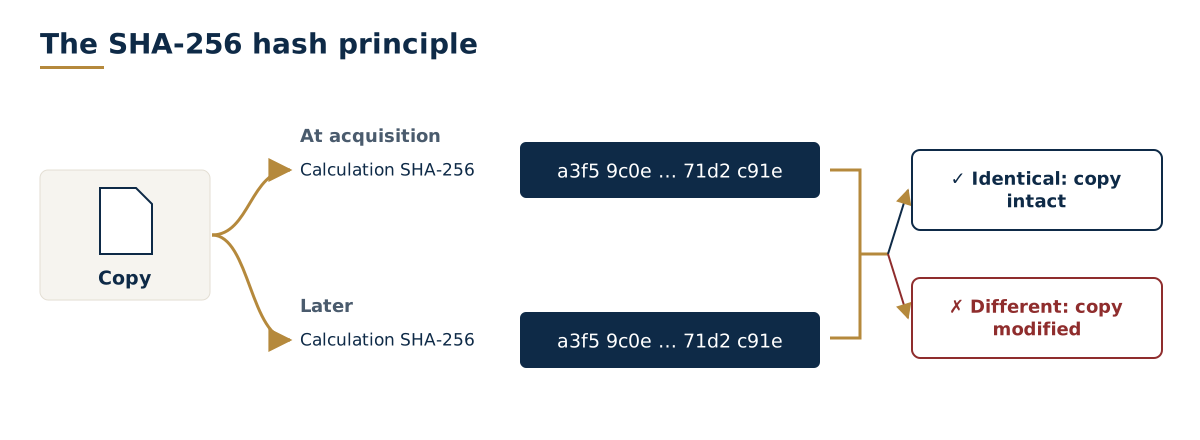
At the time of acquisition, a SHA-256 cryptographic hash of the copy is calculated. It is a string of 64 characters that changes completely with the slightest change to the content. Any expert can recalculate the hash of the copy and compare it with the one in the report: if they are identical, the copy has not changed since the acquisition. The analysis is always carried out on a working copy, never on the original.
Does an acquisition change the phone?
Not always, but sometimes, and it has to be said. Switching on the screen, connecting a cable or trusting a computer already produces traces. Some methods temporarily install a component on the device. These changes are limited, known, chosen deliberately and recorded in the report. The aim is not the impossible absence of any trace, but a controlled intervention that can be explained.
Technical and legal limits
Technically, no method works on every device: the model, the operating system version, the update level, the BFU or AFU state and physical damage determine what is possible at a given time. Legally, acquisition requires a legal basis: a device belonging to the client, the agreement of its holder, or an assignment from a judicial authority. We do not examine a third party's device without such a basis, and we do not bypass a lock outside a legal framework.
- What the acquisition establishes: the content of the copy, the date and method of the operation, and the hash that allows it to be verified.
- What remains possible depending on the case: recovering deleted items, dating events, linking accounts or devices.
- What is out of reach: guaranteeing a result before the examination, reading what remains encrypted without the keys, acting without a legal basis.
Acquisition, analysis, interpretation: three distinct steps
- Acquisition: obtaining a faithful and verifiable copy.
- Analysis: searching for, dating and linking the relevant items in that copy.
- Interpretation: stating what these items make it possible to establish, and what they do not.
The report keeps these three levels separate. The legal characterisation of the facts and the evidential weight of the items are then for the lawyer and the court. Lawyers will find details of our support on the page for legal practitioners.
Professional technologies for digital investigations
For the forensic acquisition and analysis of smartphones, the laboratory uses three professional solutions: Cellebrite Inseyets, MOBILedit Forensic and Belkasoft X. No software covers every model, every operating system version and every app. Having several technologies makes it possible to choose the right method for each device and to verify the results.
- Cellebrite Inseyets (Cellebrite): a digital forensics suite that combines data access and extraction (UFED) with the decoding and analysis of the extracted data (Physical Analyzer), for iOS and Android devices.
- MOBILedit Forensic (Compelson, Czech Republic): a solution that extracts data from phones, smartwatches and cloud services, analyses app content and produces reports, using logical and physical methods.
- Belkasoft X (Belkasoft): an acquisition and analysis environment that handles mobile, computer and cloud sources in a single case, starting with the least intrusive methods.
A multi-technology approach. Each software package has its strengths depending on the model, the operating system version and the apps involved. The tool is chosen according to the device and the questions raised by the assignment, not the other way round.
Independence from vendors. We use these programs under licence, as users. We are neither a reseller nor a partner of these vendors, and the choice of a tool is driven solely by the needs of the examination.
Cross-validation of results. When an item is decisive, it can be cross-checked with a second tool or verified directly in the source files, such as app databases. The report states the tool and its version for each finding, and points out any discrepancies.
Cellebrite, Inseyets, UFED, MOBILedit and Belkasoft are trademarks of their respective owners. Their mention implies neither partnership nor certification by these vendors.
In practice: what should you do with your phone?
If you need to entrust us with a phone: do not switch it off, do not reset it, do not update it, do not uninstall anything, and cut its network connections if you can. Have the passcode ready if it is your own device, and contact us before doing anything else with it. If you think your phone is being monitored, first read our pages on a hacked smartphone and spyware and trackers. For lost or deleted data, see our data recovery page.
Glossary
- Acquisition
- Documented and verifiable copy of a device's data, on which the analysis is carried out.
- AFU (After First Unlock)
- State of a device that has been unlocked at least once since it was started.
- BFU (Before First Unlock)
- State of a restarted device that has not yet been unlocked.
- Chain of custody
- Traceability of every handover, operation and transfer of an item of evidence.
- FBE (File-Based Encryption)
- Per-file encryption used by Android.
- FFS (Full File System)
- Extraction of a device's complete file system.
- SHA-256
- Hash function that produces a 64-character fingerprint, used to verify the integrity of a copy.
Frequently asked questions
What is a smartphone forensic acquisition?
It is the documented copy of a phone's contents, sealed with a SHA-256 hash, on which the analysis is then carried out. The original is no longer handled after this step, except where necessary and recorded.
Can a locked phone be examined?
It depends on the model, the operating system version and the state of the device. With the passcode provided by its owner, the acquisition is generally more complete. Without a passcode, the options can be very limited, and we cannot guarantee anything before examining the device.
Can deleted WhatsApp messages be recovered?
Sometimes, partially. Traces may remain in the app's databases, in backups or on a correspondent's device. On a recent encrypted phone, a message deleted long ago is often unrecoverable. Only an examination can tell.
Has my iPhone or Samsung been hacked?
An acquisition followed by an analysis can look for indicators of compromise: configuration profiles, unknown apps, abnormal behaviour, known traces of spyware. It can establish the presence of indicators; the absence of indicators does not always prove the absence of compromise.
Does the acquisition change the phone?
It can cause limited technical changes, for example connection traces or a temporary component. These changes are controlled, described in the report and have no effect on the data examined.
Why should the phone not be switched off?
A restart puts the device back into the BFU state: some of the encryption keys are no longer available and some data becomes inaccessible. It is better to keep it on and charged, isolated from networks, and to contact us.
Can the report be used in court?
The report is written so that it can be produced in court: method described, hashes, chain of custody, limits set out. Its admissibility and evidential weight are assessed by the court hearing the case, and your lawyer remains your point of contact on this question.
What is the difference between a logical extraction and an FFS extraction?
A logical extraction recovers what the system agrees to deliver, like a backup. A full file system (FFS) extraction copies the file tree, including internal app databases and many logs. It is richer, but it is not possible on every device.
Can an acquisition be carried out remotely?
Not of a phone without its user's knowledge. With the agreement of the account holder, some data can be collected from their cloud accounts or backups, remotely and in a documented way. The acquisition of the device itself is carried out with the device present.
How long does it take?
The acquisition itself takes from a few hours to a day, depending on the volume and the method. The analysis and the report then take from a few days to a few weeks, depending on the questions asked. A timeframe is proposed after the first discussion.
References
References checked on 15 November 2026. They describe good practice and architectures; citing them does not mean that the laboratory is accredited or certified against any of them.
- NIST SP 800-101 Rev. 1, Guidelines on Mobile Device Forensics (May 2014)
- ISO/IEC 27037:2012, guidelines for identification, collection, acquisition and preservation of digital evidence
- SWGDE 18-F-003-2.0, Best Practices for Mobile Device Evidence Collection & Preservation, Handling, and Acquisition (version 2.0, 21 August 2025)
- Apple Platform Security, Data Protection
- Android Open Source Project, File-based encryption
Do you need a smartphone examined, for proceedings, a dispute or a doubt about its security? Contact us before doing anything with it: we will tell you what to do with the device until it is examined.