
A question without a good answer
Until now, the person concerned had two options, and neither was satisfactory. Repeat a full forensic analysis at regular intervals: it is the most reliable method, but it is heavy for long-term follow-up. Or install a security app and rely on it: that helps, but an app reports, it does not decide. Its alerts land on the screen of someone who has neither the time nor the reference points to sort them. An alert that nobody reads protects against nothing.
The same applies to organisations. Many monitor their servers and workstations, but rarely their teams' phones. Yet that is where messaging apps, bank confirmation codes and access to work email are found, and therefore where intrusion attempts concentrate: phishing links received by text message, malicious apps, surveillance software installed without the user's knowledge.
What the Mobile SOC does
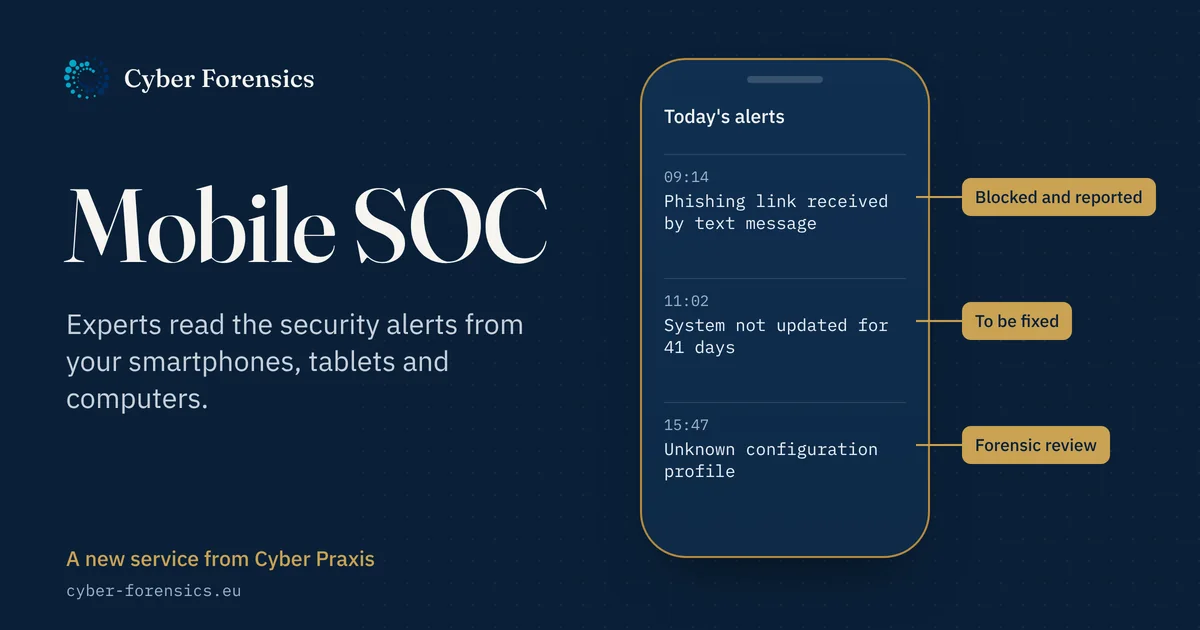
A SOC (Security Operations Centre) receives the security alerts of an IT environment and decides what to do with them. The Mobile SOC applies this principle to the devices people carry everywhere: smartphones, tablets and laptops. It rests on four elements.
A protection agent is installed on each device. It reports risky apps, phishing links, suspicious Wi-Fi networks, a system that is no longer up to date or security features switched off. Its alerts reach us: an analyst reviews them during the hours set by the agreed service level, discards false alarms and says plainly what needs to be done.
A forensic check takes place at regular intervals, for example every quarter. It is the essential complement to the agent, because some spyware is designed to evade the protections installed on the device. We look for known indicators of compromise, unexpected configuration profiles and unexplained remote access.
A monthly report takes stock: alerts received and how they were handled, overdue updates, published vulnerabilities that affect the models and versions in use. It is written to be read by management, a DPO or a private individual.
Finally, if an alert is confirmed, an intervention follows, using the method of our expert examinations: contain the incident without destroying what may serve as evidence, then preserve the relevant items with a copy, a cryptographic hash and a documented chain of custody. They therefore remain usable; their evidential weight is for the court to assess.
A line we hold
Misused, a security tool installed on a phone can become a surveillance tool. So we draw the line clearly: the Mobile SOC protects a device for the person who uses it. We do not look at the content of messages, photos or emails, unless a suspicious trace found during a check requires it. We do not geolocate anyone. And we never install anything without the user's knowledge: that is exactly what the spyware we look for does.
In a company, deployment is prepared with the DPO: prior information for staff, a purpose limited to security and, for a personal device, the employee's consent. In Belgium, the GDPR applies and, for private-sector employers, so does Collective Labour Agreement No. 81 on the monitoring of electronic online communication data. In France, employees must be informed in advance and, from 50 employees, the CSE (works council) must be consulted.
No tool detects everything. The Mobile SOC reduces the risk, it does not remove it, and every report states what was checked and what was not.
Key takeaway
Smartphone security is not settled once and for all. A one-off analysis establishes the state of a device on a given date; lasting protection requires an agent on the device, a human eye on its alerts and a regular forensic check. That is the combination the Mobile SOC offers, to individuals after an incident, to organisations and to high-risk profiles.
The service is available by quote, in Belgium and France: full details are on the Mobile SOC page.
By Jean-Pierre Heymans, entered in the Belgian national register of judicial experts (EXP2018610).